

Most articles answering this question conclude that a coating saves you thousands against waxing.
Run the actual numbers and it does not, at least not against doing the waxing yourself. Over five years they land within a couple of hundred dollars of each other.
That sounds like an argument against coating. It is not. The real argument is a different one, and it is worth getting to.
The five-year comparison
| Waxing it yourself | White coating | |
|---|---|---|
| Product | $300 to $500, around 60 applications | $960 |
| Your time | Around 30 hours | None |
| Correction likely at 3 to 5 years | From $500 | Included as preparation at the start |
| Follow-up clean and washing guidance | Not applicable | Included |
| Five-year cash total | $800 to $1,000 | $960 |
| Per week | $3.08 to $3.85 | $3.69 to $6.15 |
On money alone, it is a draw. Per week it is also a draw, which is the same fact stated twice rather than a second argument.
Where it stops being a draw is Black. At $1,440 it is the most expensive option on this page and, at $3.08 to $3.96 a week across seven to nine years, the cheapest one per week. That is not a sales trick, it is what happens when something lasts twice as long for half again the price.
Paying someone to wax the car is a different calculation entirely and the coating wins comfortably, but most people asking this question are weighing it against doing it themselves.
So what are you actually buying?
Two things, and neither is a cash saving.
Around 30 hours of your time. Wax lasts about four weeks, so keeping a car genuinely waxed for five years is around 60 applications, at half an hour or so each. If you enjoy that, it is not a cost. If you do not, it is 30 hours you get back.
Far less handling of the paint. This is the one that matters more.
None of which makes waxing a mistake. Aaron does his own vehicles and some of the products overlap with what we use. If you enjoy the process, the maths is close enough that it comes down to how you want to spend the time. Our professional versus DIY comparison goes through that properly.
Where the money actually goes
Worth understanding, because it explains why quotes vary so much.
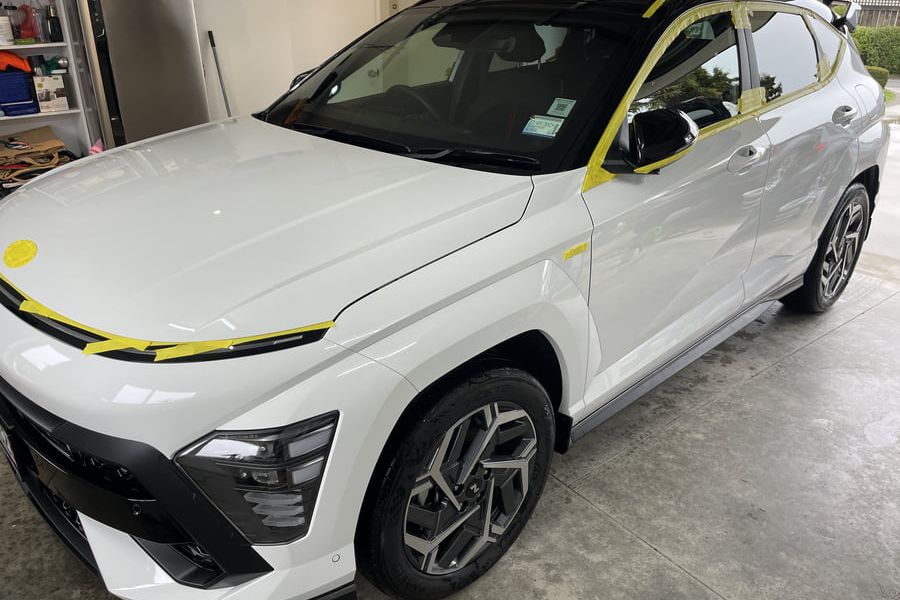
A coating job is a full day, usually six to ten hours. Applying the product is a small fraction of that. The rest is decontamination, assessment under inspection lighting, and preparation.
That is why a $300 quote and a $1,400 quote are not the same job. The cheap one usually means the car got washed rather than decontaminated and corrected, and the coating went straight over whatever was already there.
What pushes the cost up
Paint condition. The single biggest variable. Correction beyond light polishing typically starts around $500, less only for a small area.
Vehicle size. A small hatchback and a full-size 4WD need very different amounts of product and time.
Coating choice. Black over White is $480 more on a sedan, for roughly double the expected life.
Full pricing across all sizes is in our cost guide. Our pricing calculator will give you a figure for your own vehicle straight away.
Coating early is the cheapest version
On a new or near-new car, preparation is light polishing rather than correction. There is nothing to fix yet.
Wait two or three years and the same coating needs correction first, which typically starts around $500. Same product, same day of work, meaningfully higher total.
That is the strongest financial argument in the whole subject, and it is about timing rather than product. Our new car article covers the windows.
Does it add resale value?
Not directly, and we would rather not claim otherwise.
A coating will not add a line item to what your car sells for. What it does is keep the paint in the condition that makes a buyer feel good about the vehicle. Paint that has not accumulated five years of swirl marks photographs better, presents better in person, and does not prompt the conversation about whether it needs a polish.
On a private sale that is worth something. Putting a number on it would be inventing one.
Is it worth it on a cheaper car?
Asked often, usually about something in the $8,000 range.
If you have the money, yes. It probably will not add value. But helping to maintain the value it has could well be worth it, and so is simply enjoying how the car looks day to day.
The comparison that helps: what do you think the car looks like in five years with protection, against without?

When it is not worth it
You are selling within a year or two. A coating will not have time to earn itself back. A sealant, lasting up to about 12 weeks, makes more sense.
The paint is badly damaged and you want it perfect. The coating is fine. The correction needed first is where the money sits, and there is a limit to what polishing recovers. Deep scratches, chipped paint and damaged clear coat do not come out.
You genuinely enjoy waxing. The numbers are close enough that this is a real reason.
Roughly half the people we inspect decide not to proceed on that vehicle, and it is almost never about price. It is that once they see what the paint will realistically come back to, the result is not what they had pictured. That conversation costs nothing and saves people from spending on the wrong thing.
The short answer
Worth it if you are keeping the car a few years, you would rather not spend 30 hours maintaining the paint, and you want it to still look right at year five.
Not worth it if you are selling soon, or if you enjoy doing it yourself and the time is not a cost to you.
Worth it sooner rather than later either way, because new paint is the cheapest paint to protect.
"Aaron came to my place of residence and did an amazing job removing the oxidation on the bonnet and roof, then gave it a great wax/polish. I've had my car professionally groomed before at 3 times the cost of Aaron's and won't go anywhere else, I'm sold."
— Cyndy Dever
Want the numbers for your car?
Tell us what you drive and how long you are keeping it, and we will give you a realistic figure rather than a starting-from price.
What happens next: Free consultation → Transparent estimate → Professional application → Follow-up care