
TL;DR
- •Nelson's UV: We're one of New Zealand's highest UV exposure areas — wash more regularly in summer to prevent UV-baked contaminants degrading your coating
- •Salt Air: If you're within a few kilometres of the coast, rinse your car weekly — salt deposits are a slow but consistent threat to coating longevity
- •Summer Priority: Bird droppings and tree sap need removing within hours in Nelson's heat — not days
- •Winter: Less urgent washing but decontamination is more important — wet Nelson winters deposit more organic matter on paint
- •Annual Check: Book a professional decontamination wash once a year — it extends coating life significantly in this climate
- •Warning Signs: Reduced water beading, water sheeting flat instead of rolling off, or a dull look in direct sunlight all mean your coating needs attention
If you've read generic ceramic coating maintenance guides and found the advice a bit vague — "wash monthly, avoid harsh chemicals" — you're not wrong to want more specifics. Generic advice is written for everywhere, which means it's optimised for nowhere in particular.
Nelson has a climate that's genuinely harder on ceramic coatings than much of New Zealand. Understanding why — and adjusting your routine accordingly — is the difference between a coating that performs for five or six years and one that's looking tired by year two. This article covers the environmental factors specific to this region and what they mean for your maintenance schedule season by season. For the fundamentals of washing technique and product selection, our general ceramic coating maintenance guide covers those in detail.
Why Is Nelson's Climate Particularly Hard on Ceramic Coatings?
Three environmental factors make Nelson tougher on car paint than most New Zealand locations — and all three affect your ceramic coating in different ways.
UV Exposure
Nelson consistently ranks among the highest UV exposure areas in New Zealand, with long dry summers. UV is the primary driver of paint oxidation and one of the biggest threats to coating performance over time. Your coating does its job protecting the paint — but the coating itself is being worked hard.
Coastal Salt Air
Salt particles suspended in coastal air settle on paintwork constantly. They're not immediately visible, but they're hygroscopic — they attract and hold moisture against the surface. Over time, salt deposits that aren't regularly rinsed off contribute to micro-corrosion in any unprotected areas and wear on the coating's surface chemistry.
Seasonal Extremes
Nelson gets genuinely hot, dry summers and noticeably wet winters. That thermal cycling — expanding and contracting paint through wide temperature ranges — stresses any coating over time. The wet season also brings more organic matter onto paint: leaf tannins, tree sap, and pollen are all mildly acidic and accelerate surface degradation.
What This Means in Practice
A ceramic coating handles all of these challenges better than bare paint or a basic sealant — that's the point of having one. But the coating is doing real work. Maintaining it properly means you're extending that protective layer's lifespan, which directly protects the paint underneath. Ignore it and you're not immediately exposing bare paint, but you're shortening the window before you need to look at recoating or correction work.

In Nelson's wet winters, a well-maintained ceramic coating sheds water cleanly — reducing the time contaminants sit on your paint
What's the Best Ceramic Coating Maintenance Schedule for Nelson's Seasons?
Nelson's seasons each present different challenges. A one-size-fits-all monthly wash schedule doesn't account for the fact that summer in Nelson is significantly more aggressive on coatings than winter — or that spring brings its own specific hazards.
Summer — December to February
Most demanding season for coatings
The Risks
- ▲Bird droppings: In summer heat, bird mess becomes corrosive within hours, not days — remove immediately
- ▲Tree sap: Resin and sap from trees in hot weather bonds quickly to surfaces
- ▲UV-baked contamination: Any dirt sitting on the surface during high UV days bonds harder and faster
- ▲Salt accumulation: Warm, dry periods concentrate salt deposits rather than washing them off
What to Do
- ✓Wash fortnightly minimum (weekly if parked under trees or near the coast)
- ✓Always wash in shade or during cooler morning/evening hours — never in direct midday sun
- ✓Keep a quick detailer spray in the car for spot-treating bird droppings immediately
- ✓Dry thoroughly after washing — water spots form fast on hot paint in summer
Autumn — March to May
Transition season — decontamination window
The Risks
- ▲Leaf tannins: Decomposing leaves release mildly acidic tannins that stain and etch if left sitting
- ▲Increased bird activity: Berry-eating birds drop highly acidic waste in autumn
- ▲Summer buildup: End-of-summer contamination from insects, sap, and road tar accumulates on the coating surface
What to Do
- ✓Autumn is the ideal time for a professional decontamination wash — clears summer buildup before winter
- ✓Don't let leaf matter sit on the vehicle — especially in damp conditions
- ✓Check water beading performance — if it's reduced from summer, a decontamination may restore it
Winter — June to August
Lower maintenance frequency, higher contamination risk
The Risks
- ▲Coastal salt spray: Winter winds carry more salt inland from the harbour — rinse regularly even if you don't do a full wash
- ▲Road grime: Wet weather stirs up road contamination that bonds to surfaces in layers
- ▲Organic matter: Wet conditions mean fungal spores, algae, and lichen start to appear on neglected surfaces
What to Do
- ✓Monthly wash is sufficient if the car is garaged — fortnightly if parked outside
- ✓A quick rinse with a hose after particularly windy or salty days costs you two minutes and does real work
- ✓Drying is just as important in winter — standing water in panel gaps promotes contamination
Spring — September to November
Most underestimated season for paint damage
The Risks
- ▲Pollen: Nelson's spring pollen season is heavy — pollen is mildly acidic and forms a film on painted surfaces that's surprisingly difficult to remove if baked on
- ▲Spring sap: Trees releasing new growth often drip sticky residue onto vehicles parked beneath
- ▲UV returning: UV intensity climbs quickly in spring — contamination starts to bake on again
What to Do
- ✓Don't park under flowering trees during peak pollen weeks
- ✓Wash weekly during peak pollen season — pollen film builds fast and needs consistent removal
- ✓Spring is a good second window for professional decontamination, preparing the coating for the summer UV season ahead
Due for a Professional Maintenance Wash?
A professional decontamination wash in autumn or spring removes the contamination that regular washing can't touch — and meaningfully extends your coating's lifespan.
What happens next: Free consultation → Transparent quote → Professional application → Follow-up care
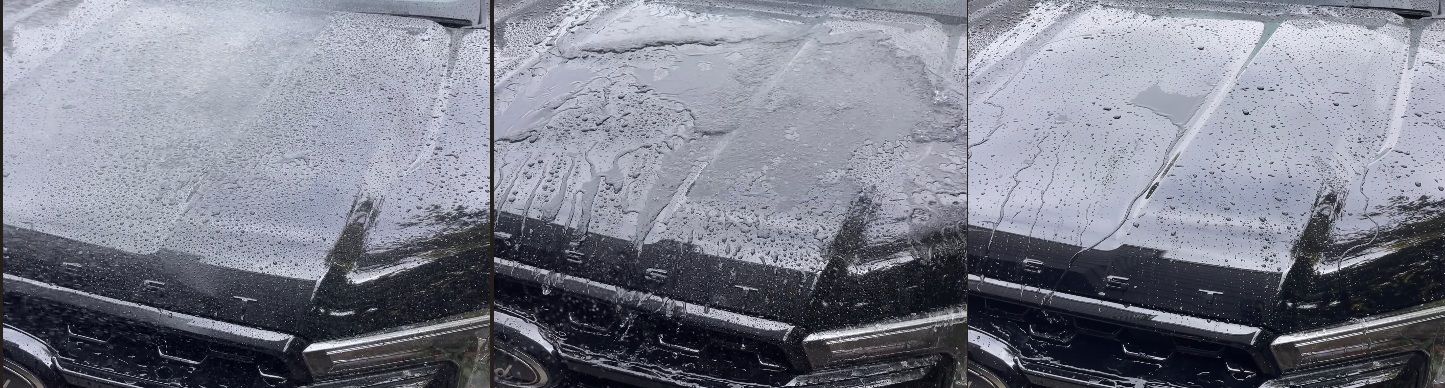
When water stops beading and starts sheeting flat, it's a sign the coating surface needs a decontamination wash — not necessarily recoating
What Does Nelson's Salt Air Do to a Ceramic Coating Over Time?
Salt air damage is slow and invisible until it isn't. Unlike a bird dropping that you can see immediately, salt particle accumulation is gradual — but it's happening every day your car is parked outdoors in Nelson.
How Salt Affects a Ceramic Coating
Salt itself doesn't immediately eat through a quality ceramic coating — that's one of the reasons a professional coating is worth having near the coast. But salt deposits that aren't regularly rinsed off cause two problems over time:
- 1. Surface micro-etching — salt crystals are abrasive at a microscopic level. In combination with wind-driven dust, they act like very fine sandpaper against the coating surface, dulling the gloss over time.
- 2. Moisture retention — salt is hygroscopic, meaning it draws moisture from the air and holds it against the surface. In any unprotected areas (stone chips, panel edges), this accelerates corrosion significantly.
The Two-Minute Rinse Rule
If you live or work close to the coast, a quick rinse with a hose after particularly windy days is one of the highest-value maintenance habits you can build. You don't need shampoo, a wash mitt, or any equipment. Just running clean water over the panels after a blustery day flushes salt deposits before they concentrate and do sustained damage. It takes two minutes and has a measurable impact on how long your coating performs.
What Are the Warning Signs That Your Ceramic Coating Needs Attention?
Most of the time, a change in your coating's performance is not a sign that the coating has failed — it's a sign that the surface needs a proper decontamination wash. Knowing the difference saves you from unnecessary recoating costs and from ignoring something that actually needs attention.
Fixable With a Decontamination Wash
- → Reduced water beading — water sitting flat on the surface rather than beading up is almost always contamination buildup, not coating failure
- → Dull finish under sunlight — a hazy or less glossy appearance that appears gradually is typically bonded contamination sitting on the coating surface
- → Paint feels rough — running a gloved hand over the paint and feeling texture or grit means bonded contamination that a clay treatment can remove
May Need Professional Assessment
- → Visible etching or marks — circular or irregular marks in the paint surface that don't wash off may mean acid damage has penetrated the coating
- → Water not moving at all at speed — a well-performing coating causes water to sheet off at highway speeds; if it isn't, the coating may be significantly degraded
- → Approaching the 5-year mark — even a well-maintained coating benefits from a professional inspection to assess whether it still has adequate thickness
Don't Assume the Coating Has Failed
In our experience, most customers who contact us concerned their coating has stopped working are actually dealing with contamination buildup — something a professional decontamination wash resolves in a single visit. A full recoat is rarely needed before the 5–7 year mark on a well-maintained vehicle. Before making any decisions about recoating, get a professional assessment first. As we cover in our maintenance guide, reduced beading is a common and fixable issue.

A properly maintained ceramic coating in Nelson holds its gloss for years — but it does require the right routine for this climate
What Annual Ceramic Coating Service Actually Extends the Life of Your Coating?
Regular home washing handles surface contamination. What it can't do is remove the bonded contamination — iron particles from brake dust, embedded road tar, mineral deposits from hard water — that accumulates on and within the coating surface over months of driving.
What a Professional Decontamination Wash Includes
- 1. Iron fallout removal — chemical treatment dissolves brake dust particles that are literally embedded in the coating surface. After this step, a dark purple/red reaction fluid is common on the rinse — that's the contamination you can't see but have been driving with.
- 2. Tar spot removal — solvent-based treatment specifically for bitumen and road tar deposits that pH-neutral shampoo cannot touch
- 3. Clay bar treatment — mechanical decontamination to restore a smooth, clean surface that allows the coating to perform at its best
- 4. Inspection — assessment of the coating's condition and whether any remedial work or a top-coat application is warranted
When to Book It in Nelson
For Nelson's climate, we recommend once a year — either at the end of summer (March/April, to clear the UV season's accumulated contamination) or at the start of spring (September, to prepare the coating for summer). If you're in a high-salt-exposure area or do a lot of highway driving, twice a year is worthwhile.
The cost of a professional decontamination is significantly less than a recoat or correction job, and it measurably extends the life of the coating you've already paid for. It's the most cost-effective maintenance investment you can make in your ceramic coating — particularly in this climate.
Questions About Your Coating?
If you're not sure whether your coating needs a maintenance wash, a decontamination, or something more — give us a call. Honest advice costs nothing, and we'd rather help you extend what you have than sell you something you don't need.
What happens next: Free consultation → Transparent quote → Professional application → Follow-up care